
5 Stars….Romance, Dancing, Pride, Prejudice, and a Beautiful Reading Experience.
Pride and Prejudice is among the most famous romance novels of all time. Jane Austen’s 1813 novel begins by introducing the reader to the Bennets, a family of five eligible daughters, eccentric mother, and a detached father. While Pride and Prejudice doesn’t strictly follow the traditional format of a story–exposition, rising action, climax, falling action, resolution–the story effectively uses small events throughout the story to establish lessons about marriage, relationships, and love. The two Bennet’s the story focuses are Jane (the oldest) and Elizabeth (the primary protagonist and the second to oldest sister). Jane meets Charles Bingley, the newest eligible bachelor in the neighborhood, at a dance and the two begin navigating a love story with twists, turns, conniving sisters, heartbreak, and doubt. At the same evening Elizabeth encounters Mr. Darcy, Mr. Bingely’s friend, who is crass, cold, and has a stead fast objecting to dancing. In the months to come Elizabeth will encounter Darcy several times-both on purpose and without intent–and the reader is taken on a ride that follows the pair dealing with their prejudices against one another as they are not from the same social class and their individual pride that accompanies their headstrong personalities.
In the end, Elizabeth and Darcy, and Jane and Bingely give the reader a new perspective on the intricacies of love and how it always prevailed even when countered with wild elopements, denied proposals, lies, smoldering army officers, and flamboyant patronages.
Pride and Prejudice uses slow but effective characterization to show us Darcy and Elizabeth’s similarities and differences–all of which keep the reader guessing as to what will become of their relationship. For instance early on it appears the Darcy is simply cold when latter, certainly by the middle of the book, it becomes clear that Darcy is merely unable to see past the pride he takes in his social status and connections in order to realize Elizabeth is more “agreeable” then he originally thought.
Austen uses side characters effectively to teach the reader about relationships not rooted in love–like Charlotte and Mr. Collins who marry for status and security– and Mr. Bennet and Mrs. Bennet. By showing the reader the pitfalls of marriage as stipulated by the status quoe the reader is inclined to root for Jane and Elizabeth to marry their potential suitors because they are in love.
Overall, Pride and Prejudice is a story worth reading because it reminds you that love is both worth waiting for and more complicated then tends to appear.
I give Jane Austen’s Pride and Prejudice 5 stars.
So…Who Cares?
Pride and Prejudice was originally published in 1813. Why should readers still endeavor to navigate the twists and turns of Elizabeth Bennet’s adventures at Longbourn?
This question demands a bit of multi faceted answer:
- First, I believe that the age of the book has little to nothing to do with the relevance of the text. While it is true that the social constructs of society have significantly changed since P and P was originally published suggesting that alone makes it irrelevant neglects the undeniable fact that our history is always relevant. If our history isn’t relevant, if we don’t learn from our mistakes we won’t move forward. Our “old” stories play a big and important role in keeping this from happening.
- Our interpretation of text changes over time and in the allows us to draw new conclusions and lessons. This is beneficial because the more ways we as people can see the same story the easier it becomes for people who disagree to see the other’s point of view–and understand it.
- In order to move art forward we must understand it’s roots. Enough said.
- The notion that old stories have no bearings on us today is inherently false. Stories like P and P remind us that the human experience has been affected by the same problems, ideas, and motivations since…well…forever. Understanding this idea can lead you to new answers to some of life’s biggest, essential, and complicated questions.
But why P and P? There are a lot of old books! What makes this one so special?
Quote Courtesy of Rob Cline
“Jane Austen is the template for the courtship novel.”— Louis Bayard, award-winning author whose new book, Courting Mr. Lincoln, is an Austen-esque tale of a young Abraham Lincoln and two suitors for his affection in Springfield, Ill. One is Mary Todd; the other is Joshua Speed.
Louis Bayard laid it out plain and simple in an interview he did with local press this April. Jane Austen sets the template, the standard, the bar, for courtship romance novels. She is the quintessential romance writer. Without her the genre doesn’t really exist.
Okay, but is it really that beautiful? I mean, no one actually writes like that.
Well, false. Jane Austen uses her sharp wit to create comedic and beautiful scenes that are enhanced by metaphors and hyperbole, and other figurative language (all are used very sparingly) that bring the story to life through profound dialogue. Here are a few a examples of figurative language found throughout the book:
Metaphor: Dancing
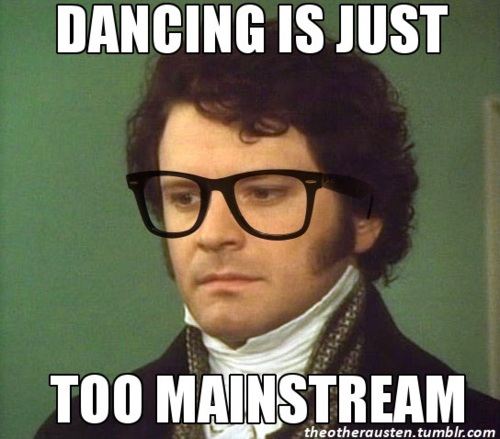
Throughout, the book Elizabeth (and Jane) find themselves at extravagant dances/balls. But these dances do more than just create a setting, they function as a metaphor for falling in love. For instance, Jane and Bingley, and Elizabeth and Darcy share many of their most important moments together at these balls while pulling towards and away from each other. This process of asking one another to dance, impatiently waiting to be asked, tripping on toes, and falling towards and away from one another is a metaphor for the twists and turns of falling in love. Oh, and, Mr. Darcy ineptness for dancing is a metaphor for ineptness in love.
Hyperbole: Jane is dying!
P and P frequently uses hyperbole within character’s dialogue. This device is especially important to Austen indirect characterization of Mrs. Bennet. Here’s an example:
” ‘I am sure,’ she added, ‘if it was not for such good friends I do not know what would become of her, for she is very ill indeed, and suffers a vast deal, though with the greatest patience in the world’” (p. 29).
In this quote from the expedition of the story Mrs. Bennet is exaggerating Jane’s illness, making it seem like Jane is dying. Therefore, this quote reveals to the reader that Mrs. Bennet has dramatic tendencies. (We, as the readers, learn a few pages back that the illness in question is nothing more than a cold.)
No, really, are the themes that really that important?
Let’s break this down: Pride and Prejudice is a romance novel that satirizes courtship and marriage without love. Austen’s point, her main issue, the theme of the story is the importance of love in a marriage and the barriers in society that can cause love to be absent in marriages like pride, prejudice, class, and reputation. These are themes that explored in love songs, in plays and musicals, and in countless other stories. We continue to read, listen, and watch these stories because they continue to help us answer our own questions about relationships and what role love (both platonic and romantic) play in those relationships (marital or otherwise) as our relationships with the people around us remain ever important to us.
This video breaks down the major themes in the book and uses examples throughout the story that illustrate those themes.
In summary, Jane Austen sets the standard for courtship novels by writing with undeniable wit, brilliant (if ever scarce) figurative language, while addressing literary themes that remain relevant to us even today. All the while Austen causes us to ask new questions, and develop new lines of thoughts about the characters and their individual pride and prejudices–forcing us to examine our own.
Mr. Collins Proposal to Elizabeth Bennet
The original scene is described here (Summary for chapter 19-21) and is told using third person perspective. This version of the scene is told through Mr. Collins perspective.
Truthfully, I thought that Elizabeth would be thrilled with the notion of matrimony. She wouldn’t have to worry about moving out of Longbourn or having to fret over where her unmarried sisters or mother would live after Mr. Bennet’s passing.
Then again, she has been stubborn, strong-headed, and dare I say completely disagreeable during the duration of my stay when it comes to matters of practicality. Silly girl. She really is to stubborn for her own good. I am sure that she will change her mind–I will not be off put by that smug look on her face. I am a clergyman after all and it woulds be foolish to refuse me the pleasure of having her hand. It is almost certain that Mr. and Mrs. Bennet will agree and the matter will be settled before evening tea.
Her wit is simply not enough to inspire many other suitors to pursue her. Jane is much prettier and Lydia is arguably more talented. Her sisters out shine her in almost every way. She should be relived that someone with the economic security and status I possess would even glance at her.
But if Mr. Bennet fails to convince her, perhaps it will have been for the best because after all Lady Catherine won’t accept just anyone.
Allusions in Pride and Prejudice
It was difficult to find clear allusions in Pride and Prejudice because Austen uses humor, metaphors, and similes to tell the majority of her story. However, here are two literary allusions from the P and P that helps give the story some historical context.
#1:
Mr. Darcy:
“I have been used to consider poetry as the food of love.” (pg. 45)
This is an allusion to Shakespeare’s Twelfth Night. The quote is a reference to the phrase from Twelfth Night: “If music be the food of love, play on.” The Twelfth Night is a play about outward appearances. In the play one of the female characters is mistaken by the Duke for a man simply because she is disguised as one and the Duke can’t see past what’s on the outside. In Pride and Prejudice, Austen has Elizabeth falling into this same trap: she can only see that Darcy as crass and uncaring even though he is benevolent on the inside.
#2
Mrs. Bennet
“Why, my dear, you must know, Mrs. Long says that Netherfield is taken by a young man of large fortune from the north of England; that he came down on Monday in a chaise and four to see the place, and was so much delighted with it, that he agreed with Mr. Morris immediately; that he is to take possession before Michaelmas, and some of his servants are to be in the house by the end of next week.” (Pg. 1)
Michaelmas is a Christian festival observed on September 29th on some Western liturgical calendars. Mrs. Bennet’s reference to the holiday alludes to the historical context in which the novel is set. The book is thought to be set contemporary to Austen’s time in the early 1800s Britain where religion (especially Christianity) played a significant role in everyday life.
Oh, and it’s worth mentioning that Pride and Prejudice is one of the most alluded to books of all time. There are tons of books and movies that have taken the timeless story and made it their own including: The Lizzie Bennet Diaries,Bridget Jones’ Diary, and Pride Prejudice and Zombies.
What’s With The Marriage Thing?
After completing well over half of Jane Austen’s Pride and Prejudice I have found myself wondering what the history is behind the importance of young women getting married during the period the book was written in, the 1800s.
But let’s backtrack for a second; for those unfamiliar with the book, Pride and Prejudice is about marriage. As you move through the story you see Austen comment on marriage that isn’t inspired by love–Charlotte Lucas and Mr. Collins (a nincompoop of a person)–in order to secure a financial stable and socially acceptable life. At the same time Austen creates a deep romance between Elizabeth Bennett and Mr. Darcy that struggles to blossom due to their own pride and prejudice against one another.
Which, leads to some questions…
What’s the big deal with getting married? Why can’t Elizabeth live at home with her parents until she’s ready to own her own house? Why must Charlotte suffer Mr. Collins? Why is marriage so important to Mrs. Bennett that it almost feels as if she wouldn’t mind if anyone, anyone at all, proposed to her daughters?
Check out the sources below to find out!
This video does a great job explaining what the heck is going on with all the marriages in the book and the reasons they occur.
Check out this link for a broader historical analysis of gender roles and marriage in the 19th century:
https://www.bl.uk/romantics-and-victorians/articles/gender-roles-in-the-19th-century
It is a Truth Universally Acknowledged…
Now that I am several chapters into Jane Austin’s Pride and Prejudice I am happy to report that I find the exposition to be effective in enticing the reader to become invested in the story. The central plot of the story(explained in summary here:
https://www.sparknotes.com/lit/pride/summary/ ) lends itself to a satirical commentary on the social norms of Austin’s contemporary society. This kind of commentary appeals to me as a reader because I like to read books where you have to look past the initial words and understand the deeper and–more often than not– the historical factors which account for the tone, humor, and references made throughout the story.
I think right before the story begins the Bennet daughters have recently reached appropriate ages to be married. As this occurs, Mrs. Bennet’s stress about marrying them well (something she has undoubtedly considered since the day they were born) grows and begins to be the focus of her every waking moment. This, of course, is the state in which we initially meet Mrs. Bennet and the story truly begins when her emotion on the subject is catalyzed even further by the arrival of Mr. Bingely, and all to an ideal suitor for one of her daughters.
Austin does not spend much time describing the setting of the story. She does, however, elect to name several estates where much of the action takes place. These estates are revealed to include horses and large homes. You might see large gardens and perhaps a pond. Each estate is said to vary in size and worth. Regardless the reader is lead to believe that most, if not all of them, are rather impressive in a plethora of facists.
Three Facts about Pride and Prejudice:
- P and P is a story told largely using dialogue. Because of this, we are able to learn about many characters through a lot of direct characterization. That being said, the way the person speaking phrases their ideas and the tone their words assists the reader greatly by indirectly characterizing the person speaking.
- P and P was originally published in 1813 and is widely regarded as one of the best romance novels of all time. This does mean that the sentence structure and vocabulary is very different from contemporary English.
- P and P is so popular that its first sentence remains ingrained in the minds of many as it is frequently referred to in an array of other artistic works: “It is a truth universally acknowledged, that a single man in possession of a good fortune, must be in want of a wife.” (Austin, 1)
Three Opinions about Pride and Prejudice:
- The best character the reader is introduced to in the first several chapters is Mr. Darcy. He is described as proud and disagreeable. This is why I find him interesting. He is gloomy and arrogant while it seems almost everyone else is nearly perfect in the eyes of almost all of the characters.
- Mrs. Bennet is hysterical. She is constantly working to appear as if she is immune to surprise and aware of everything everyone is doing around her. The amount of effort she expends in this regard, makes me laugh because this is a completely (and quite obviously so) an unobtainable goal.
- The reader should get to know more about Kitty Bennet sooner in the story. It feels odd to know in Chapter 3 that she has an uncontrollable cough and not know anything else about her for many chapters after that first introduction.
Maybe by the next post I will have more to report about Kitty…….
Reading Schedule!
Starting today, April 10th, I will need to read 20 pages everyday to finish my novel by April 26th.
Why Pride and Prejudice
I chose to read Pride and Prejudice because I have tried to do so–and failed to do so– in the past. My past failures weren’t from a lack of interest or a distaste for the style of the book. In fact, I love Austin’s quick wit and admire her ability to immerse her readers in the worlds she creates for her characters.
The problem has always been time. I simply haven’t been able to commit enough time to finish the book. When it is all said and done, I don’t prioritize reading for fun. Well, that changes now. I’m on a mission to not only finish Pride and Prejudice but also to remember why I love to read. Maybe in that process, I will be reminded why good stories are always worth our time.
Writing this blog will be a way for me to share my experience of rediscovering my love of reading with others. Simply put, I’m excited to get started.

